DX-AllSuite Architecture Overview
This guide provides a comprehensive overview of the DXNN (DEEPX Neural Network) SDK architecture, its core modules, and supported environments.
Why DX-AllSuite?
DX-AllSuite integrates the complex pipeline—from model optimization to target hardware deployment—into a Single Workflow.
- Zero-Code Deployment: Deploy logic verified on a desktop directly to edge devices without any code modifications.
- Resource Optimization: Reduce the time spent on environment setup and system integration, allowing you to focus on building high-performance AI applications.
- End-to-End Solution: Provides model compilation, simulation, runtime execution, and monitoring within a single package.
System Architecture & Core Modules
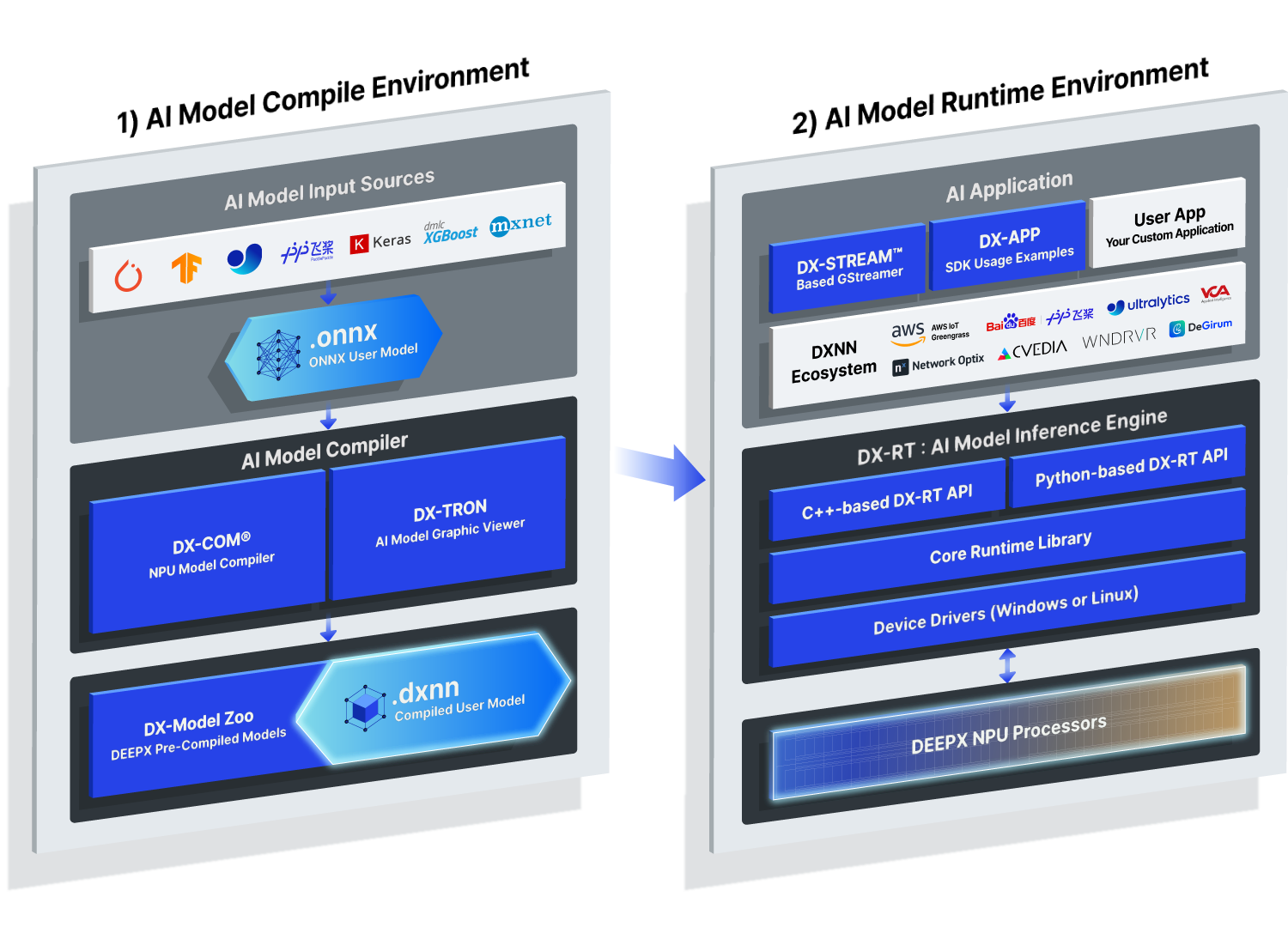
Figure. DXNN SDK Full Architecture Overview.
[1] AI Model Compile Environment (Host Platform)
This environment converts and optimizes trained AI models into DEEPX NPU-proprietary binaries (.dxnn). It supports the x86_64 PC environment.
- DX-COM (Compiler): The core compiler that generates
.dxnnbinaries based on ONNX models and user configuration (JSON) files. It uses proprietary algorithms to convert models into hardware-optimized instructions while minimizing accuracy loss, enabling low-latency and high-efficiency inference. - DX-TRON (Visualizer): A GUI tool for visualizing and analyzing the structure of
.dxnnmodels. It provides color-coded graphs to intuitively show workload distribution between the NPU and CPU, helping developers understand execution flow and optimize performance. - DX-ModelZoo: A repository of pre-trained models optimized for DEEPX NPUs. By providing ONNX models, JSON configs, and pre-compiled
.dxnnbinaries, it allows developers to test and deploy models immediately without going through the compilation process.
[2] AI Model Runtime Environment (Target Platform)
This environment runs optimized .dxnn models on actual NPU hardware and integrates them into applications. It supports both x86_64 and aarch64 environments.
- DX-RT (Runtime): The core software that interacts with firmware and drivers to run
.dxnnmodels on the DEEPX NPU. It manages model loading, I/O buffers, inference execution, and real-time monitoring, offering flexible control via C/C++ and Python APIs. - DX-APP: Sample applications built on DX-RT. It provides reference code for key vision tasks (Object Detection, Face Recognition, Image Classification, etc.), enabling developers to quickly build unique AI apps using these templates.
- DX-Stream: A GStreamer-based custom plugin that connects real-time video data to DEEPX NPU inference. It provides a modular pipeline covering pre-processing, inference, and post-processing, optimized for high-performance vision AI applications like intelligent cameras.
- Driver & FW: Supports high-speed data communication via the PCIe interface and manages NPU resource scheduling and power. It ensures stability between hardware and software while maximizing the hardware's potential for a seamless inference environment.
Development Workflow
The path from a trained model to NPU acceleration follows four logical steps.
- Step 1. Model Preparation: Export a model trained in PyTorch or TensorFlow to the ONNX format.
- Step 2. Optimization (Host): Compile the model using DX-COM with quantization and hardware optimization to generate a
.dxnnfile. - Step 3. Deployment (Target): Transfer the generated
.dxnnfile to the target device. - Step 4. Execution (Target): Run high-speed inference on the DEEPX NPU via DX-RT.
Technical Compatibility (Support Matrix)
DX-AllSuite provides proven compatibility with the latest operating systems and a wide range of hardware architectures, ensuring a stable bridge between your development environment and edge deployment.
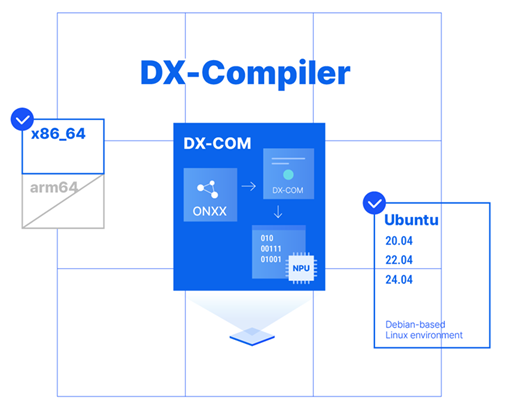
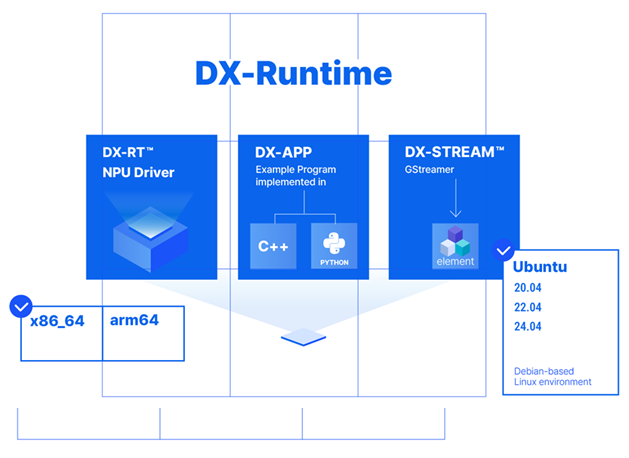
Figure. DX-Compiler & DX-Runtime Support Ecosystem.
Hardware & OS (Platform)
The following table outlines the supported environments for both the compilation (Host) and execution (Target) phases.
| Category | DX-Compiler (Host) | DX-Runtime (Target) |
|---|---|---|
| Architecture | x86_64 | x86_64, aarch64 |
| OS | Ubuntu 26.04/24.04/22.04/20.04, Fedora, Redhat, CentOS | Ubuntu 24.04/22.04/20.04, Debian 13/12, Windows 11/10 |
| Languages | Python 3.8, 3.9, 3.10, 3.11, 3.12, 3.13, 3.14 | Python 3.8 or higher, C++14 or higher (C++17 for MSVC/Windows) |
Model & Software Ecosystem
Supported AI Frameworks
DX-AllSuite seamlessly integrates with industry-standard frameworks to minimize refactoring.
- Frameworks: Ultralytics (YOLO), TensorFlow, PyTorch, Keras
- Formats: ONNX (Primary exchange format)
Global AI Ecosystem Partners
We maintain strong technical partnerships to ensure the DXNN SDK operates flawlessly within various industry-leading platforms.
- Cloud & Platform: AWS (IoT Greengrass), Baidu, DeGirum
- Vision & Algorithms: Ultralytics (YOLO Series), CVEDIA
- VMS & Security: Network Optix (Nx), VCA (Applied Intelligence)
- Embedded OS: Wind River (VxWorks)
DEEPX ModelZoo & Supported Tasks
DEEPX ModelZoo is a comprehensive repository providing over 358 pre-validated models. It allows users to immediately verify performance and accuracy across various hardware profiles without the need for a manual compilation process.
| Task | Representative Models |
|---|---|
| Image Classification | ResNet, ResNeXt, MobileNet, EfficientNet (Lite/V2), ViT/DeiT/BEiT, MobileViT, FastViT, CasViT, RegNet, ShuffleNet, VGG |
| Object Detection | YOLO families (YOLOv3–YOLOv11, YOLOX, YOLO26), SSD, EfficientDet, NanoDet, DamoYOLO |
| Instance Segmentation | YOLACT, YOLOv5-Seg, YOLOv8-Seg, YOLO26-Seg |
| Semantic Segmentation | DeepLabV3/DeepLabV3+, SegFormer, BiSeNet, UNet |
| Oriented Object Detection (OBB) | YOLO26-OBB |
| Zero-shot Instance Segmentation | FastSAM |
| Face Detection | RetinaFace, SCRFD, ULFGED, YOLOv5-Face, YOLOv7-Face |
| Face Recognition | ArcFace (IResNet50/100, MobileFaceNet, R50) |
| Face Landmark | TDDFA v2 (MobileNet variants) |
| Face Attribute | FaceAttrResNetV1-18 |
| Pose Estimation (Human) | CenterPose, YOLO26-Pose, YOLOv8-Pose |
| Hand Landmark | MediaPipeHandsLite |
| Person Attribute | DeepMAR (ResNet18/50) |
| Depth Estimation | FastDepth, SCDepthV3 |
| Image Denoising | DnCNN variants |
| Low-light Enhancement | ZeroDCE |
| Super-resolution | ESPCN (x2/x3/x4) |
Key Features of the ModelZoo Pipeline
- YAML-Centric Orchestration: Manage pre-processing, post-processing, evaluation, and compilation settings in a single YAML file for high reproducibility and easy operation.
- Unified Workflow: Integrates list, info, eval, compile, and benchmark functions into a single CLI system, allowing flexible combination of stages.
- Optimized Multi-Profile Support: All models are quantized and optimized for the DEEPX NPU architecture, ensuring consistent validation from ONNX evaluation to NPU execution.
- Extensible Registry: Supports plugin-style extensions for pre/post-processing, datasets, and evaluators, enabling fast onboarding of custom models.
- Broad Task Coverage: Extensive support for service-ready CV tasks beyond basic classification and detection, including Face Analysis, OBB, and Image Enhancement.